

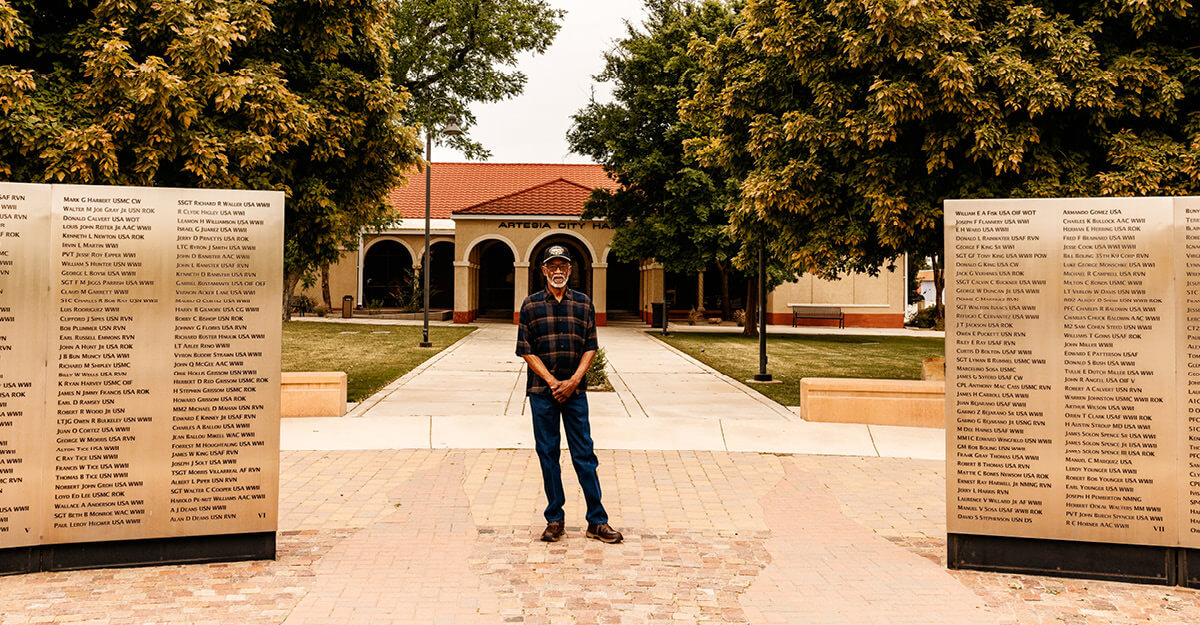
George Mullen has never been one to seek the spotlight.
That much becomes clear within minutes of talking to him. There is no rehearsed story, no polished narrative meant to impress. Just a steady voice, a few quiet laughs, and a consistent thread that runs through every chapter of his life: when something needs to be done, you step up and do it.
Mullen, an Artesia native, carried that mindset with him when he joined the United States Navy. His path there was not complicated. He watched his older brother serve and felt the pull to follow. He considered the Air Force, but when the opportunity presented itself, he chose the Navy and never looked back. What began as a decision grounded in practicality turned into a 23-year career that would shape how he sees the world and his place in it.
In the Navy, he found what he was looking for, even if he did not know how to name it at the time. He found structure, yes, but also something more important: the expectation that you think, adapt, and contribute. As a data processor, what we now call information technology, he spent his career working with systems that were constantly evolving. From early shipboard machines to the first wave of desktop computing, he lived through a period of rapid change that required both discipline and creativity.
That expectation to think for yourself stayed with him. “In the Navy,” he explained, “just because I know something does not mean that is the only way it can be done.” It is a simple idea, but it says a lot about how George Mullen approaches problems: listen, consider, then act.
Before ever stepping into public office, George built a life around helping people in practical ways. After retiring from the Navy, he worked with the Department of Labor, helping connect people to jobs and training opportunities. It was the kind of work that does not draw headlines but changes lives quietly, one conversation at a time. “I help you as best I can,” he said. “I have always been that type of person.” That same mindset eventually led him to run for Artesia City Council. Not because he was looking for a title, but because he saw a gap that needed to be filled.


His service in the Navy also gave him something else that does not always show up on a resume: perspective. He saw and lived in many cities across the country. He worked with people from every background imaginable. He learned how different systems function, and just as importantly, how they do not. And through all that, his appreciation for Artesia only grew.
George made a deliberate choice to come home to Artesia. His parents were still here, well into their later years, and he wanted to be present. There was no hesitation in that decision. Family came first. At the same time, he and his wife were raising young children, and Artesia offered something he valued deeply: a strong school system and a community that still takes care of its own. “I knew Artesia had a great school system,” he said. “That was part of it.”
He could have gone elsewhere. His experience in technology opened doors in larger cities like Washington D.C., Memphis, or New Orleans. But bigger was never the goal. Being rooted, being present, being useful; that mattered more.
Before ever stepping into public office, George built a life around helping people in practical ways. After retiring from the Navy, he worked with the Department of Labor, helping connect people to jobs and training opportunities. It was the kind of work that does not draw headlines but changes lives quietly, one conversation at a time. “I help you as best I can,” he said. “I have always been that type of person.” That same mindset eventually led him to run for Artesia City Council. Not because he was looking for a title, but because he saw a gap that needed to be filled.


He did not even enter the race in a traditional way. George ran as a write-in candidate, making the decision late in the process when he realized the race needed someone willing to stay focused on Artesia itself. And then he did what he had always done. He showed up.
He knocked on doors. He talked to people. He leaned on a small but committed group that believed in him. There was no elaborate strategy. When asked about the success of the campaign—especially because winning as a write-in candidate is a huge feat—George said, “I never really thought I wouldn’t win because I have confidence in myself. Plus, the team that I had. I had a lot of confidence in them, and my manager steered us in the right direction, and everything worked out.” George Mullen won his first election the same way he lived his life: through trust built over time.
During his time on the council, he approached the role with the same clarity he brought to the Navy. Focus on the job. Solve the problem. Do not overcomplicate it. He tells a story about a loose sewer cover in his district. A resident mentioned it, George passed it along to the appropriate department, and it was fixed within a day. To him, this is exactly how local government should work. People speak up, leaders listen, action follows. There is no need to make it more complicated than that.
For George Mullen, voting is not optional; it is essential. He speaks about it plainly, without frustration but with a kind of steady insistence that is hard to ignore. Too many people, he believes, want outcomes without engaging in the process that creates them. They want things fixed but do not take the simple step of showing up at the ballot box. “You want everything done the way you want it,” he said, “but you will not put in your word, which is that vote.”

It is not a criticism as much as it is a challenge. “Participate in the process” was the backbone of George’s campaign, as well as the backbone of his political ideology. That belief is rooted in something deeper than politics. It goes back to how he understands service itself. For George Mullen, patriotism is not loud or performative. It is not something you turn on in moments of crisis and forget the rest of the time. It is consistent. “You do not have to be patriotic only in the public’s eyes. Be it all the time.” That idea connects everything: his time in the Navy, his work in the community, his approach to leadership. It is all the same quiet, steady thread.
Ask George about Artesia, and the answer comes quickly. He loves it here. Not in a vague or sentimental way, but in a grounded and practical sense. It is a place where people still know each other. Where kids are supported. Where opportunity exists if you are willing to work for it. He talks about the schools, the programs, the investment in young people, and you can hear a kind of pride that does not need to be overstated. “It is a great place to live,” he said.
At the same time, he understands the balance that makes a place like Artesia special. Growth matters, but so does preserving the character of the community. Even now, stepping away from public office, he is still thinking about how to contribute. Maybe it is through helping veterans, maybe it is through something entirely different. What matters to him is staying useful. Because for George Mullen, that is the point.
There is a temptation, especially in stories about service, to look for defining moments, turning points, headlines. His story does not quite work that way. Instead, it is built on something quieter and, in many ways, more meaningful. A lifetime of consistent choices: to come home, to help where he can, to step in when it matters, to stay engaged.
In a time when it is easy to assume that individual effort does not make much of a difference, George Mullen offers a steady counterpoint. It does matter. It always has. You just have to be willing to show up.
Article written by Morgan Fox and originally published in Focus on Artesia 2026 Summer edition.

Morgan Fox
I wear many hats: wife, mom, entrepreneur, travel enthusiast, interior designer wannabe, writer, enneagram type 7, margarita connoisseur. The list goes on because, heck, I'm a Gemini too and if you've met any of those, you know what I'm talking about. I have a spirit for adventure and hometown pride. I love a good road trip and finding new places to explore.